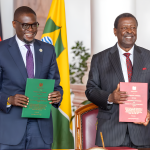
A significant cultural and political event unfolded in Ong’er Grounds, Nyatike Constituency, Migori County, Kenya, as Deputy President Kithure Kindiki was crowned a Luo elder and bestowed with the traditional name “Odhiambo.” This historic moment, marked by vibrant ceremonies and warm community reception, signifies a step toward national unity and cross-cultural collaboration in Kenya’s diverse political landscape. The crowning of Kindiki as a Luo elder not only highlights his growing influence as a national leader but also underscores the spirit of inclusivity championed by the Kenya Kwanza administration and its partnership with opposition leader Raila Odinga.

The ceremony in Migori was more than a political gathering; it was a celebration of Luo culture and a testament to Kenya’s commitment to unity. Kindiki, a soft-spoken technocrat and former Interior Cabinet Secretary, was honored by local elders and community leaders in a symbolic gesture of respect and acceptance. Draped in traditional Luo regalia, he was presented with a spear and shield, symbols of leadership and protection, and gifted the “seat of power,” signifying his new role within the community. The crowning moment came when he was given the Luo name “Odhiambo,” a name meaning “born in the evening” in the Luo language, reflecting his calm and composed demeanor.
The event was attended by high-profile leaders, including Treasury Cabinet Secretary John Mbadi, Senate Majority Leader Aaron Cheruiyot, Migori Governor Ochillo Ayacko, Migori Woman Representative Fatuma Mohamed, Nyatike MP Tom Odege, and Migori Senator Eddy Oketch, among others. Their presence underscored the political weight of the occasion, as leaders from diverse regions and political affiliations came together to witness this cross-cultural bridge-building.
The name “Odhiambo” carries deep cultural significance within the Luo community, one of Kenya’s largest ethnic groups, constituting 10.65% of the population. The Luo, a Nilotic-speaking people native to western Kenya and northern Tanzania, have a rich tradition of naming that reflects circumstances surrounding a child’s birth. According to Luo custom, names like Odhiambo (for males) and Adhiambo (for females) are given to children born in the evening or at dusk, typically between 3 PM and 6 PM. The name is derived from the Luo word “odhi,” meaning “to be born,” and signifies a connection to the time of day, often associated with calmness and reflection.
By naming Kindiki “Odhiambo,” the Luo elders acknowledged his peaceful and unifying approach to leadership. This gesture is not merely symbolic but a profound act of cultural integration, signaling acceptance of a non-Luo leader into the community’s fold. It aligns with the Luo tradition of honoring individuals who demonstrate statesmanship and contribute to communal harmony.

The crowning of Kindiki as a Luo elder comes at a time when Kenya’s political landscape is undergoing significant transformation. The event is closely tied to the recent collaboration between President William Ruto’s Kenya Kwanza coalition and opposition leader Raila Odinga, a prominent Luo figure and former Prime Minister. Kindiki, speaking at the event, praised Odinga for his statesmanship and willingness to work in a broad-based government, emphasizing that Kenya’s interests supersede individual ambitions. He lauded Odinga’s decision to join forces with Ruto as a model of nationhood, urging other leaders to emulate this spirit of unity.
This partnership, often referred to as the “broad-based government,” aims to bridge political divides and focus on development for all Kenyans, regardless of their voting patterns in the 2022 elections. Kindiki highlighted ongoing and planned development projects in Migori, including affordable housing in Sori and Rongo, hostels at Rongo University and other technical institutes, and three fish landing sites to boost the local economy. These initiatives reflect the government’s commitment to equitable development, a key pillar of Ruto’s Bottom-Up Economic Agenda (BETA).
The event also served as a platform for Kindiki to address opposition critics, dismissing them as less formidable due to the government’s focus on service delivery over political rhetoric. By aligning with Odinga, a respected elder statesman, the Kenya Kwanza administration seeks to foster stability and inclusivity, a message Kindiki reiterated during the ceremony.
Kithure Kindiki’s rise to prominence has been marked by his reputation as a technocrat with a hands-on approach to governance. As Deputy President, he has sought to redefine the office by focusing on development and national unity rather than engaging in political contests. His tenure as Interior Cabinet Secretary was notable for addressing security challenges in regions like the Kerio Valley and streamlining passport services across the country. His recent absence from public events, which sparked speculation of a rift with President Ruto, was clarified as a brief holiday, reaffirming his commitment to supporting Ruto’s agenda.
Kindiki’s crowning as a Luo elder adds a new dimension to his role as a national leader. Hailing from Tharaka Nithi, a region far removed from Luo Nyanza, his acceptance as an elder in Migori signifies his ability to transcend ethnic and regional boundaries. This aligns with his broader vision of professionalizing the Deputy President’s office, focusing on tangible results rather than political posturing.
The Luo Council of Elders plays a pivotal role in preserving the community’s cultural heritage and mediating social and political matters. Historically, the Luo government structure was decentralized, with sub-tribes led by a “ruoth” (chief) advised by a council of elders known as “galamoro mar jodongo.” The current “ker” (spiritual and cultural leader) of the Luo, Jaduong Odungi Randa, was crowned in December 2023, continuing the tradition of leadership that balances cultural preservation with modern governance.
The crowning of Kindiki by the Luo elders reflects their recognition of his contributions to national unity and development. It also builds on historical efforts to foster cohesion between communities, such as the 2020 meeting where Kikuyu elders endorsed Raila Odinga in Bondo, signaling a strengthening of Kikuyu-Luo ties. Such intercultural exchanges are vital in a country with a history of ethnic-based political tensions.
The event generated significant buzz on social media, particularly on X, where posts celebrated Kindiki’s new title and name. Users like @citymirrorKE and @MKMadoka_ shared images and updates, noting the cultural significance of the ceremony and its role in promoting unity. The hashtag #KindikiOdhiambo trended briefly, with Kenyans expressing pride in the blending of cultures and the government’s inclusive approach. However, some posts on X also sparked debates about the political implications, with a few questioning whether the move was a strategic play to bolster support in Nyanza ahead of the 2027 elections. These discussions, while inconclusive, highlight the event’s resonance in Kenya’s dynamic political discourse.
The crowning of Kindiki as a Luo elder carries profound implications for Kenya’s social and political landscape. First, it reinforces the narrative of unity championed by the Ruto administration and its collaboration with Odinga. By embracing leaders from diverse backgrounds, the government signals its commitment to inclusivity, a critical factor in addressing Kenya’s history of ethnic divisions. Second, it elevates Kindiki’s stature as a national leader capable of bridging regional and cultural gaps, positioning him as a key figure in the Kenya Kwanza coalition.
Moreover, the event underscores the importance of cultural diplomacy in modern governance. By participating in and honoring Luo traditions, Kindiki sets a precedent for other leaders to engage with Kenya’s diverse communities, fostering mutual respect and understanding. This is particularly significant in Nyanza, a region that has historically supported Odinga and the opposition, as it demonstrates the government’s willingness to invest in areas beyond its traditional strongholds.
While the event was widely celebrated, it was not without scrutiny. Some political analysts suggest that Kindiki’s crowning could be perceived as a calculated move to gain favor in Nyanza, a region critical to the 2027 elections. Others argue that such cultural gestures, while symbolically powerful, must be backed by sustained development efforts to avoid being seen as tokenism. Additionally, Kindiki faces the challenge of balancing his national role with regional expectations, particularly in his home base of Mt. Kenya, where he has been endorsed as a regional leader by some MPs, creating tensions with other political figures.
The crowning of Deputy President Kithure Kindiki as a Luo elder named “Odhiambo” is a landmark event in Kenya’s journey toward unity and inclusivity. By embracing Luo traditions and aligning with Raila Odinga’s vision of nationhood, Kindiki has solidified his role as a bridge-builder in a diverse nation. The ceremony, rich in cultural symbolism and political significance, reflects the power of collaboration in addressing Kenya’s challenges. As the country moves toward the 2027 elections, such moments of unity will be crucial in shaping a cohesive and prosperous future. With ongoing development projects and a commitment to equitable governance, Kindiki’s new title as “Odhiambo” may well become a beacon of hope for a united Kenya.